











At the centre of it all sits a pool table, unexpected and almost disarming, as if to remind you that even in industries driven by engineering precision, space for pause still matters. It is here, in this fluid in-between of work and reflection, that the Managing Director of Aeson Power speaks to us about the transformation he’s making in the local automotive scene.
Rewriting a century-old component
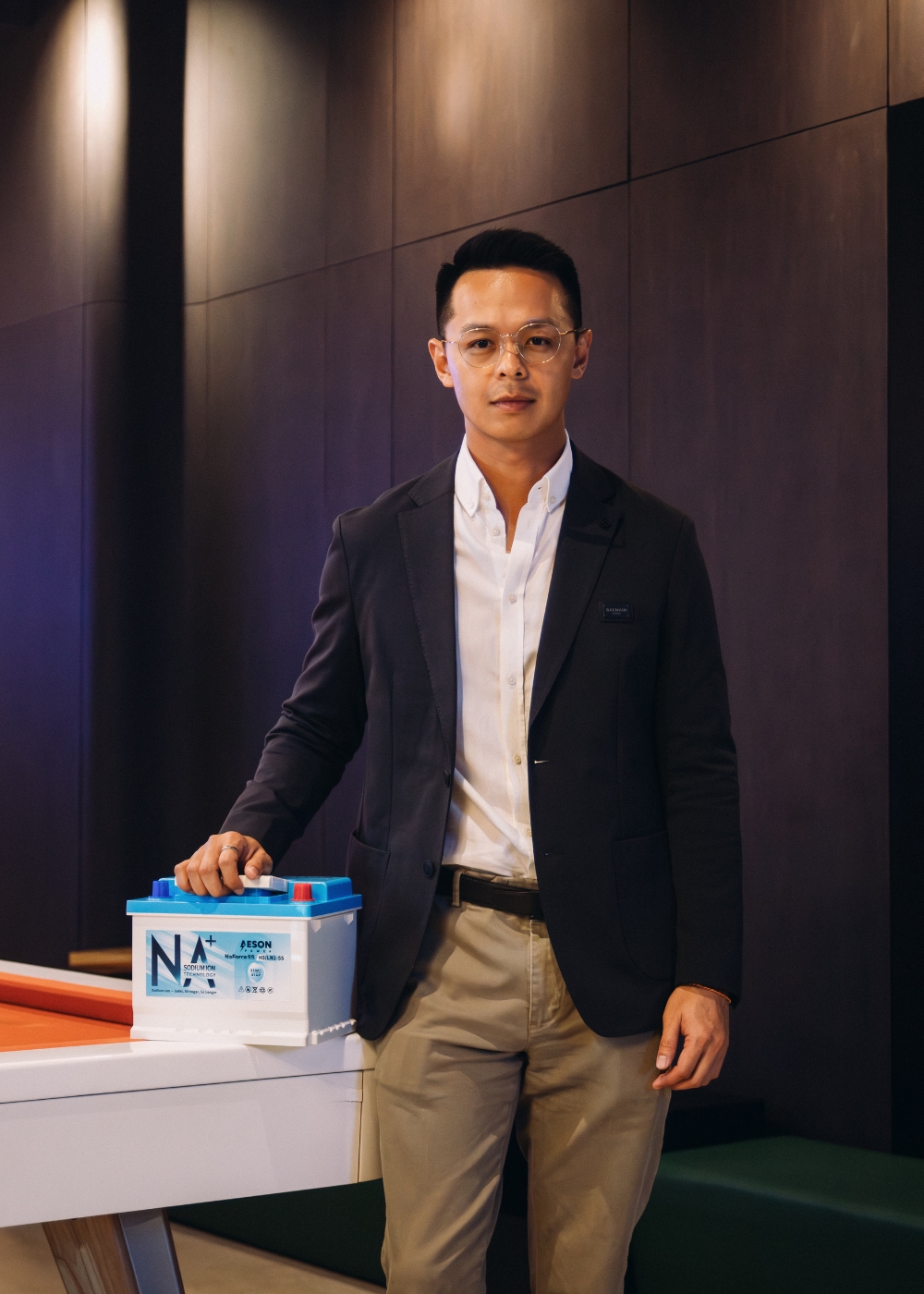
Jin’s entry into sodium-ion batteries was not driven by trend or timing, but by a simple observation: for nearly a century, the 12V car battery has barely changed. While vehicles have evolved into increasingly electrified, software-driven machines, the humble lead-acid battery under the hood has remained stubbornly the same. And yet, it is the one component that quietly determines whether your day begins or collapses.
“What inspired us,” he says, “was the realisation that the automotive battery industry had remained relatively unchanged for close to a century.”
In Malaysia, that realisation carries weight. The country’s automotive landscape is unusually large for its size, with around 21 million registered four-wheel vehicles and annual sales consistently exceeding 700,000 units. Cars are not a luxury object in this market – they are infrastructure. And almost all of them rely on the same ageing battery technology.
That dependence, Jin points out, is where the problem begins. Most drivers only think about their car battery when it fails — often without warning, often at the worst possible time. In real-world conditions, many batteries last only around 18 months before needing replacement. The inconvenience is not just mechanical, but emotional: disrupted plans, stalled mornings, stranded moments.
For Jin, this fragility felt like a gap waiting to be redefined.
Sodium-ion technology, he explains, offers a different proposition altogether – not just incremental improvement, but structural change. A well-engineered sodium-ion battery can potentially last five to ten years, significantly extending reliability while reducing the cycle of replacement that drivers have long accepted as normal.
From commodity to performance system

Aeson Power’s approach was never simply about introducing a new chemistry. It was about reframing what a car battery is supposed to be.
Traditionally treated as a commodity – invisible until failure – Jin wants to reposition it as a performance component. “We want to change that perception entirely,” he says. “A car battery should be treated as a high-performance energy system.”
That shift in thinking has already translated into tangible differences. Sodium-ion batteries developed under Aeson Power are up to 73% lighter than conventional lead-acid units. They also provide more stable voltage output, supporting modern vehicle electronics that increasingly rely on consistent power delivery – from infotainment systems to sensors and air-conditioning loads.
There is also the matter of warranty – a detail Jin treats not as marketing, but as confidence. While most traditional car batteries offer around a one-year warranty, Aeson Power extends that to three.
Still, innovation in automotive energy is not just about performance metrics. It is also about context – and Malaysia, with its heat, humidity, congestion, and short-trip driving culture, provides one of the most demanding real-world environments for battery systems.
“In many ways, Malaysia is one of the toughest places for batteries,” Jin notes. High temperatures and frequent stop-start driving accelerate degradation in conventional systems. This reality shaped how Aeson Power built sodium-ion technology for durability in demanding driving conditions.
Earning trust over time

When sodium-ion batteries were first introduced, skepticism was natural. Many consumers had never heard of the chemistry before, and comparisons to lithium-ion were inevitable.
“The biggest challenge was awareness,” he says. “People needed to understand that this is not experimental science – it is next-generation technology already being developed globally.”
Over time, that hesitation began to shift. Not through advertising, but through experience. Workshops, resellers, and drivers who tested the product firsthand began to notice the differences: more stable starts, more consistent performance, fewer unexpected failures.
One of the most important lessons Jin carries is that innovation alone is never enough. Timing, education, and market readiness matter just as much as invention. “Sometimes the market may not fully understand a new technology immediately,” he reflects. “Building trust is a gradual process.”
What will shape the next energy era

Looking ahead, Jin Chan sees Malaysia is entering a critical phase in its automotive evolution, driven by electrification as well as the wider systems that support it, from energy storage to infrastructure and smarter mobility.
This shift toward sodium-ion batteries reflects how such technologies can further support this transition, especially in improving everyday reliability. While EVs often dominate the conversation, foundational components like the 12V system continue to play a crucial role in enabling this change.
But the real gap, in his view, is not technology – it is confidence among consumers and industry players that new energy systems are practical, safe, and viable at scale. “Disruption is not just about having new ideas – it is about turning those ideas into reliable solutions people can trust,” he says.
That belief underpins Aeson Power’s long-term ambition: to build a leading battery brand that can expand beyond automotive applications into wider energy storage and electrification solutions.
Transformation has never been about grand breakthroughs. It is about improving something small but essential – until it quietly changes how people move through their everyday lives.
For more inspiring people stories, head here.
Photography by Imran Sulaiman.