








Paris Fashion Week has wrapped up after a hectic nine-day schedule with a medley of fashion houses, including Dior and Chanel, to name a few. It was a spectacular affair, a reminder of why Paris continues to reign as the fashion capital shaping the industry’s upcoming trends. Jonathan Anderson and Matthieu Blazy continued to anchor at their respective maisons, while Sarah Burton and Nadège Vanhée reframed women’s tailoring with renewed precision. Discover the five Paris Fashion Week Fall/Winter 2026 shows that delivered pure runway spectacle.
Christian Dior
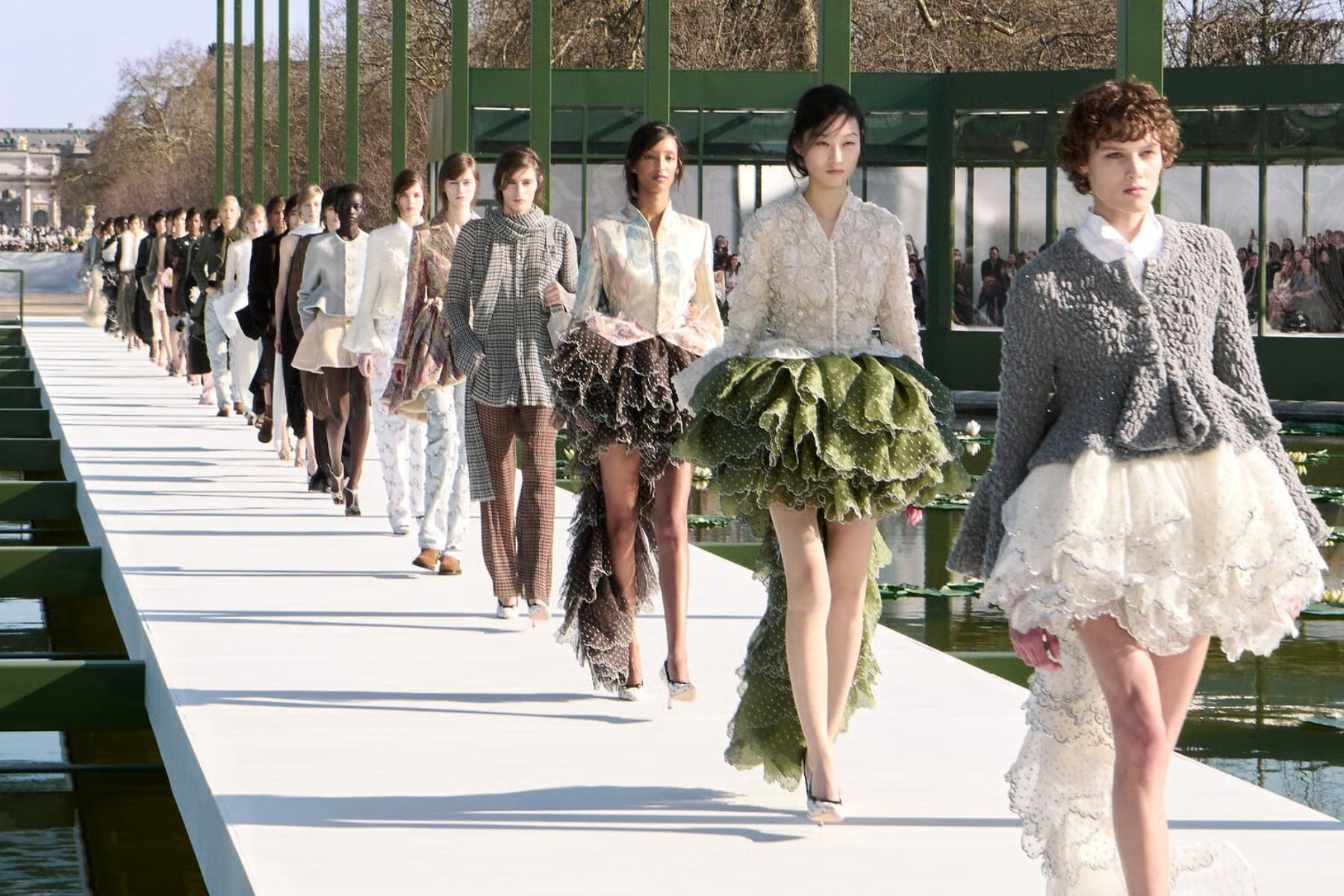
Jonathan Anderson once again proved his vision for Christian Dior with romantic whims and secret gardens. This time, he did it at the one venue that envisioned it the best: Jardin des Tuileries. Artificial water lilies scattered along the iconic Bassin Octogonal, proving that fashion should be as breezy as a walk in the park.
Titled The Craft of Artifice, the show opened with Anderson’s own reinterpretation of the Bar jacket, now in a shimmery and flowy peplum silhouette. The design is also spread across the collection in colour variations of grey, yellow, and green. Layered ruffles add volume underneath the brocade, while Anderson’s signature bow manipulation emphasises softness and passion. Not to forget the unveiling of the lily heel – garnering attention the second it walked the runway. The rounded sole was inspired by a floating lily pad, finished in textured embroidery in shades of green, with lilies blooming at the toe. Each element was maximal, providing a feast for the eyes with more details every time you look closer. It was a beautiful display of how Anderson elevated Dior’s savoir-faire, reimagining floral elements through silhouettes, prints, and motifs.
Schiaparelli
There’s hardly anyone in fashion exploring extreme craftsmanship like Daniel Roseberry. His creative compass has always pointed towards Elsa Schiaparelli, whose love for the natural world expanded into her designs. “Schiaparelli has always been radical. But it’s never been radical to the point of alienating its women. And maybe that’s the ultimate legacy of what Elsa built: clothes that made women feel more alive with the dream of who they were while also feeling comfortable with who they actually were,” said Roseberry.
The Sphynx reflected the enduring influence of Elsa Schiaparelli’s surrealist vision. The collection mostly consisted of gold and black, but it was the silhouette, craftsmanship technique, and animal-inspired designs that made it stand out. Traditional Aran cable knits are reimagined with panels of illusion tulle, creating the striking illusion of weightless heaviness. Thus, appearing substantial yet floating effortlessly on the body. Liquid plissé silk-blend fabrics are coated with a clear lamination and sculpted into spiral-cut gowns. The result is fluid yet deliberate: pieces without boning or rigid lines that provide structure while remaining malleable.
Elsewhere, the maison’s hallmark, the iconic keyhole, extended from bags to blazers, dresses, and accessories. The measuring tape motif made its appearance on Schiaparelli’s classic Vendôme jacket in stretch boiled wool. Roseberry explained that, to him, the keyhole motif symbolises more than an emblem. It’s also a metaphor of unlocking the brand’s potential and a reminder that every woman is herself an enigma to others and to herself. “Fashion is how she externalises the mystery of who she is to the world.”
Hermès
“She inhabits every moment, alert, as she traverses the space between light and shadow,” said Nadège Vanhée, Hermès’ creative director, as she described how she envisioned the women of Hermès for the Fall/Winter 2026 collection. Celestial light illuminated the Garde Républicaine’s stage, where models emerged from a moon-evoking opening while moss bloomed against the winding path.
Luxury felt effortless with Hermès. Rather than opting for the next best trend, Hermès leaned towards sharply tailored silhouettes, crafted in fluid garments. The cinematic lighting interrelated with the fabric, where dusky blue, oxblood, and oranges gleamed before turning nocturnal. Leather remained central across coats, dresses, and jumpsuits as the maison once again demonstrated its precise craftsmanship and timeless elegance. Utility and sensuality rarely meet, yet Vanhée’s adjustable zips, spiralling around the torso and hips, made it possible. “It’s about revealing and concealing. It’s not a dichotomy. It’s definitely a tandem,” she noted.
Chanel
With the theme day and night, simplicity and iridescence, the Grand Palais transformed into a construction site for one blissful evening, with towering cranes in red, yellow, and green that gleamed against the dark setting.
Matthieu Blazy’s Chanel was an equilibrium between honouring the maison’s historic house codes and turning them into something strikingly modern. Knits and tweeds moved in effortless fluidity while the caterpillar and the butterfly served as his main inspiration. It was Blazy’s way of opening a dialogue on how fashion is a coexistence between utility and transformation. As a wise man once said, the first show introduces, while the second show defines. Blazy’s sophomore ready-to-wear women’s collection further reinforces his creative direction: fluid silhouettes, exuberant accessories, and shimmering embellishments that effortlessly bring the collection from daytime elegance to luminous glamour.
Givenchy
Sarah Burton held the fashion world in thrall, and for all the right reasons. The show for Burton’s third collection was held at Hôtel des Invalides, showcasing her technical skills in well-cut dresses and tailored suits. The runway set was a giant zoetrope, with seats around the runway adding to the maze-like effect. Designed as a monumental zoetrope, the serpentine runway wrapped around guests while mirrors and dim lighting distorted sightlines, keeping each model partially hidden until she stepped into view.
Setting the tone was a sharply tailored blazer with exaggerated shoulders and collars. Silhouettes ranged between fitted, cropped, and softly draped, each emphasising the body’s natural curves. Black and grey anchored the collection, highlighted by bold bursts of orange and flashes of leopard print. Sapphire blue appeared across dresses, long coats, and leather handbags, while lemon yellow brightened the line-up through dresses, heels, and leather gloves. The bonnets scattered throughout the show may have puzzled some, but the maison later revealed their inspiration: the rich, painterly worlds of Northern European old masters. “These headwraps are the most natural hair coverings there are. Just a T-shirt. Just a twist. But it’s the right T-shirt, with the right twist,” said British milliner Stephen Jones, who designed them.
Givenchy also brought back its iconic Shark Lock Boots, first introduced in the early 2010s and subsequently received various updates from the maison’s previous creative directors. Burton’s version, however, consists of the same fold-over design and hidden heel, but now thigh-high with silver or gold hardware across the front thigh. For jewellery, self-expression is boldly made through hanging earrings, big doorknocker earrings, and equally chunky chain necklaces.
Keep up with the latest fashion news here.