








Not every fashion house can officially call itself a haute couture atelier – a ‘high dressmaking’ medium with standards so high that it is only approved if it meets the ones set by Paris’s Fédération de la Haute Couture et de la Mode (FHCM).
There are some nuances around the strict rules and regulations, but what has been confirmed to acquire the haute couture status is that the atelier must employ at least 15 full-time staff, in addition to 20 full-time technical professionals, and create made-to-order designs for private clients, with at least one fitting. The fashion house must also present a collection with at least 50 original designs every fashion season (January and July) for both day and evening looks. More often than not, these haute couture creations also take countless hours of pure artisanal handiwork, from embroidery to beading to crafting the minute details on a garment.
Fashion lesson aside, the recent Paris Haute Couture Week Spring/Summer 2026 had more reasons for the fanfare. Straight after his sophomore menswear collection for Paris Fashion Week Fall 2026, Jonathan Anderson showed his debut haute couture collection for Christian Dior. Similarly, Matthieu Blazy presented his first collection for Chanel. At Valentino – a week and a half after founder Valentino Garavani’s passing – Alessandro Michele staged a campy kaiserpanorama show, but not before it opened with a voiceover from the late Garavani from Valentino: The Last Emperor, a documentary by Matt Tyrnauer. It was a fitting tribute and teaser to the collection that was to be unveiled.
Ahead, we highlight the five best shows from Paris Haute Couture Week Spring/Summer 2026.
Schiaparelli
As the usual opener for Haute Couture Week, Schiaparelli really knows how to set the mood to kickstart the shows. From the designs to the stage to the celebrated guests of A-listers in attendance, every moment from Schiaparelli’s haute couture shows never fails to gather attention.
“The idea was to keep the rigour of the last few seasons but make it way more expressive,” said creative director Daniel Roseberry for his new couture collection, The Agony and The Ecstasy. His first point of inspiration began with the Sistine Chapel, where the historical architecture of 543 years old sparked strong emotions during his visit. “I stopped thinking for the first time in years of how something should look, but instead about how I feel when creating it,” said Roseberry. While other couturiers often take inspiration from flora, the American designer leaned towards fauna, such as exotic birds in saffron colour, blowfish with crystallised spikes, and scorpion tails. He started his sketch with reptiles – scorpions and snakes – the creatures that most people often fear.
As a pocketed playfulness in his show, Roseberry also brought a slice of the Louvre’s Apollo Gallery heist to the Petit Palais. Teyana Taylor, the maison’s muse, wore the “stolen” crown worn by Empress Eugénie, wife of Napoleon III, to the Schiaparelli show. “I was going home from a walk in the office, it was right after the jewels had been stolen from the Louvre,” said Roseberry. “I wondered – wouldn’t it be nice to reimagine the Louvre jewels that were stolen?”
Dior
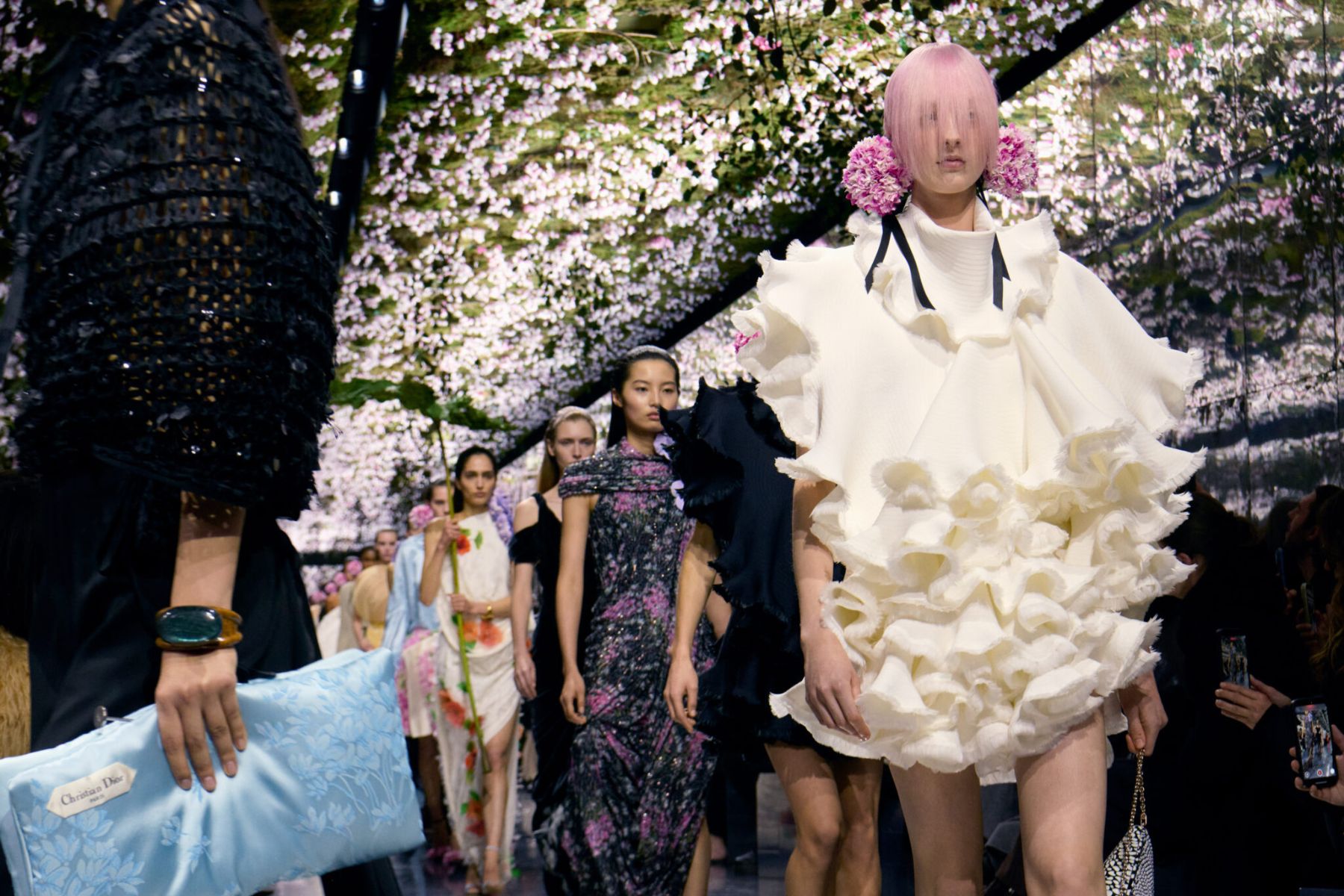
It’s hard not love Jonathan Anderson and the collections born from his whimsical imagination, combined with storied inspirations. For his first couture collection, Anderson turned Musée Rodin into an inverted meadow of blooming cyclamen. The choice of florals was far from random. They were inspired by the gift that former Dior creative director John Galliano gave Anderson a while ago: two bunches of wild cyclamen tied with black silk ribbons. The show notes called the flowers a symbol of ‘creative continuity’. “The best flowers are from Galliano – they are perfect,” said Anderson. Flowers weren’t the only gift Galliano had for the Irish designer. “The more that you love Dior, the more it will give you back,” Anderson recalled Galliano’s words of wisdom.
Thus, the collection unfolded first with a trio of bulbous pleated dresses that were inspired by a curved vase by ceramic artist Magdalene Odundo (a long-time collaborator of the designer). To achieve that balloon-like shape and airiness, the dresses were constructed from featherweight silk tulle and wire. There were also nods to John Galliano’s sinuous bias-cut gowns and Raf Simmons’ razor-sharp tailoring with the minimalist black coat that flared at the hips and paired with tufted pink mules.
Elsewhere, cyclamen reappeared as pom-pom earrings or floral embellishments on gowns. Whether it’s the Easter eggs referencing his predecessors or the knick knacks like vintage cameo brooches and meterorite shards used among the collection as adornments, it was indeed, as Anderson called it, a ‘Wunderkammer’ of ideas. One thing is certain: despite the abundance of references, Anderson made the pieces look entirely his own – romantic, artistic and deeply personal. As Rihanna easily summed up backstage with Anderson, post-show, “This is Dior. That’s what Dior is for me.”
Chanel
Matthieu Blazy, Chanel’s creative director, transformed the Grand Palais into a whimsical sanctuary for his couture debut, complete with pink weeping willow trees and giant wild mushrooms. With a stage like that set to the soundtrack of Snow White, it created the dreamiest mood for all in attendance. What followed was a collection void of Chanel’s usual signifiers like tweed and camellia flowers, which Karl Lagerfeld further cemented during his reign. Instead, Blazy’s couture for Chanel was feathery-light, set in shades of candy-sweet pastels (and a dash of finely tailored black suits and chic little black dresses), and simply joyful in a nutshell.
“First, transparency and muslin. The Chanel suit as a second skin, revealing the inner life of the wearer. Then come the birds. Of all colours, shapes and horizons. With them, a simple, joyful idea: freedom,” said the show notes. It was Blazy’s way of acknowledging Gabrielle “Coco” Chanel, who introduced a whole new world of fashion for women, liberating them from restraining corsets and into wide-leg trousers, freeing dresses and menswear cuts. He wanted to design a collection “for women to go to work, to go to a play, the cinema, whatever”.
Thus, the show began with a forty-something model – a refreshing change in the industry – walking down the runway in a classic Chanel tweed suit, except it was nude in colour and crafted from silk mousseline. A closer look unveiled the subtlest of details that Blazy is fantastic at: pearl-adorned hems and chain trimmings around the translucent layers.
There were hints of Chanel’s classic icons appearing as tokens – either in silk mousseline or as jewellery –on a palimpsest peeking out of the maison’s iconic flap bag, slipped into pockets or stitched into interiors. Eventually, clients themselves can select the motifs that are meaningful for them for the maison’s atelier to bring to life. After all, couture is made for the wearer, and Blazy made this Chanel collection directly on the body of the model. “That is the definition of couture,” he explained.
Valentino
There is something so undoubtedly camp about Alessandro Michele’s first haute couture collection, Specula Mundi. Is it the kaiserpanorama setup, an early cinematic device that predated film projection, or the cinephile set of drama? Honouring Valentino Garavani’s recent passing, the show began with the late designer’s quote from the Valentino: The Last Emperor, a documentary where he shared his formative love for cinema. “To see this sort of beauty, I decided I wanted to create clothes for ladies,” said Garavani.
Staged at Tennis Club de Paris, the collection unfolded as Erté illustrations brought into three dimensions, drawing from Hollywood glamour and theatrical fantasy. Bias-cut satin slips, velvet coats with pooling trains, feathered headdresses, and gold lamé goddess gowns reflected Ziegfeld Follies, Mata Hari, and silent-film icons that fused classical iconography with a hint of 1980s excess. Gold became both material and symbol, transforming models into secular deities, walking to a soundtrack of classical music layered with techno.
Michele’s fascination with fashion as myth-making shaped the entire experience. Framed through portholes, viewers were torn between studying the intricate craftsmanship and capturing fleeting images. It echoed the idea of couture as a rare space for unapologetic dreaming, merging Valentino’s cinematic legacy with his own maximalist vision.
Robert Wun
Robert Wun outdid himself once again. For his Spring/Summer 2026 Haute Couture collection, titled Valor: The Desire to Create, and the Courage to Carry On, it portrayed couture as an emotional battlefield shaped by doubt, pressure, and obsession. “I feel like every creative nowadays is a warrior,” Wun expressed. “They’re always battling within and externally as well. Hopefully, people can see why we need couture, where a designer can actually be themselves.”
Staged at the Lido Cabaret Club, the collection was divided into three acts: Library, Luxury: Confrontation of Reality, and Valor. It began with a narration on the pure creative impulse, which turned to a critique of luxury’s value systems, before culminating in thoughts on resilience. Throughout, Wun positioned the designer as an unseen warrior, pierced with swords yet continuing to create.
The designs mirrored this journey through sharply controlled yet theatrical silhouettes. Black-and-white looks in Library translated sketchbook purity into sculpted bodices, bolero shoulders, and flared skirts, climaxing in a 40-kilo microglass-beaded circular gown. In Luxury, models became vessels of opulence, wearing jewel-studded bodices, crystal face masks, and corsets with trailing trains. Valor introduced armour, anatomical bodysuits, and storm-lit sequined gowns to embody strength. Wun infused rebellion, dramatic execution, and an emotion for fashion’s most rarified expression.
Discover more fashion news here.